Another Golden Oldie. The last update Adrienne submitted was October 7, 2005.
~~
I recently wrote this and thought it is pretty good for a bio as it explains the diffrent types of diagnoses and problems I have, and not just Cushing’s. I can get very technical in my writing but this is not. Somehow, I find enough brain power to write; and since it’s been so long since I was first diagnosed with Cushing’s, I do know a lot of meds, etc. And kidneys. Ha. Always happy to help see email at bottom. Thank you MaryO!
I. In the Beginning
I’ve fought against this for so long that now, at the precipice of acceptance, I am reluctant even to write the words that are playing havoc with my mind. Three words, or one if you prefer the modern version- well, in a minute. I can’t say them yet.
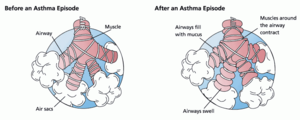
Asthma before-after (Photo credit: Wikipedia)
For the past eleven years I have been dealing with the mental effects of my illness. The illness and mental manifestations began as soon as I ingested my first corticosteroid pill while living in Indiana in 1994. Given to me for severe ‘adult onset asthma’ the steroids were the result of many emergency room visits, failed ‘breathing treatments’ for said asthma, and most probably the doctor’s unwillingness to be ‘bothered’ with such a common ailment as asthma and as such not inclined to research my symptoms further. I had never had any signs or symptoms of asthma in my 22 years of active living. I loved hiking, tennis, volleyball, basketball, you name it, I most probably did it at least once.
During this time of breathlessness and pain from breaking two ribs while violently coughing, I became severely depressed. I didn’t recognize it at the time, at least not until the asthmatic symptoms receded (due to the steroids or simply time, I do not know). I had been working three jobs for the holidays, one more than usual. I was a typical workaholic in low-paying dead-end jobs as was fitting my age and lack of degreed education. I quit all three jobs, hoping to move out of state to stay with my father for a while. I wanted a change, I was still on the steroids, was still sick and growing increasingly scared. I didn’t want to move back home to my mother in California: I felt she had had enough of me and deserved a break.
With my truck packed and my three jobs no longer a worry, I was all set to leave. I was looking forward to getting to know my father better. But the night before I was to leave, my stepmother called and said it just wasn’t a good time to come stay with them. My father had broken his ankle and was undergoing extensive surgery and therapy; but all I wanted was to be with him. I was not just discouraged from visiting, but was told in no uncertain terms that I was not welcome ‘at this time.’ I was devastated.
I moved in with a friend and I just lost it. I stayed for days on end in my bedroom, my only companion my cat, Fantine. When I wasn’t sleeping, I was writing feverishly on my old Brother word processor. I wrote the most horrible things- stupid stories, neurotic thoughts and poems. There was no internet for me at the time; no way to research information on my symptoms and medications but for the public library, which I didn’t even consider visiting as it involved leaving my bedroom. I even answered some personals and went out on two dates- something I would never normally have done. What a disaster! So much for going out… I became even more solitary.
It’s important here to note that I was once considered quite stable. Unlucky in love and a poor judge of men in general, still, I was happy on a day-to-day basis. I smiled at everyone, I laughed– I mean really laughed– regularly. I was considered ‘bubbly’ if not downright ‘giggly.’ In fact, ‘Giggles’ was my nickname! I had nearly forgotten that. I always saw the positives in any given situation, I never was depressed or sad. Well, almost never. I really enjoyed living; I got up each day with a can-do attitude. I cheered up those around me and was the optimistic one in my family as well as among my friends.
Those three words… nope. Forget it. I’m not even close to being able to write them here. Not yet.
Back to Indiana, where each day seemed bleaker and more hopeless than the one before. I broke out in hives on my face, upper arms, neck and chest. The hives stayed for eight years. Each day I tried to go without my steroid pill; and each day I went a little bit crazier. A little bit more depressed. A great yawning chasm seemed to exist between me and the rest of the population. My friends were worried about me, but not really worried enough to intervene as they didn’t really care about me. All they could see was that I was no fun anymore. Pity.
I stopped going to nightclubs which I once enjoyed. I lived on macaroni and cheese and soup from a can, barely eating enough to survive and always when my roommates were out of the house. I began to take more steroids to combat the hives, as were prescribed by doctors, never knowing that they were slowly killing me. The depression was so severe that if my roommates were in the house, I would urinate into a cup and keep it in my closet to dump out once they left. And at the time, it didn’t really seem crazy to me!
My image of myself really took a nosedive; my hives were hideous. I had always been complimented on my flawless complexion. I tried everything the doctors gave me, never thinking that the cure was so much worse than the symptoms. I was suddenly gaining weight, yet I honestly was eating less than I had before these symptoms began. I just figured that since I was no longer exercising the weight gain was to be expected. My hair had always been wavy and full of bounce, but it started to get curly- really curly. In the span of two months, I no longer recognized myself in the mirror. I remember removing the mirror from my room and never bothering to approach the one in the bathroom.
I eventually took a job with a do-it-yourself warehouse as a head cashier. I had to pay for the new truck I had and my roommates were the most fiscally irresponsible people I have ever known, so I had to earn a living. Unfortunately, I was too far behind to ever get ahead and knew that I needed to go home to my mother because I was just getting sicker. I had no energy, I slept whenever I wasn’t at work. I was having trouble concentrating, had problems with coworkers as I was a bit- how shall I say- ‘pissy.’ Conversely, I would break into tears for no reason. But the day I was to drive back to California, my truck was repossessed. I booked a flight, packaged up my boxes for cargo shipment, and was gone within a week.
What followed were two years of emergency room visits for ailments I had no previous experience with. I was gaining weight still, I had hives, headaches and such a deep sadness I didn’t know what to do, where to turn. So, I just continued on the path of work. Work had always seen me through the day; work took up the hours, made me feel needed and like a responsible citizen. Through it all, I continued to take the steroids, eventually upping the dosage according to how I felt each day.
The better jobs I landed, the better medical insurance and more willing I was to submit to seeing specialists. I had been misdiagnosed as having SLE (Systemic Lupus Erythematosus); FMS (Fibromyalgia Myofacial Pain Syndrome); and being just plain old crazy. My symptoms were starting to range quite literally in the dozens, and the list only grew as the years passed. (I was going to post it but chickened out- it’s mind-boggling, even to me).
Back to those three words. Nope, still can’t say them. Maybe tomorrow, when I shall continue my self-indulgent pity party. No, it isn’t even that: I’m trying to get to the heart of the matter but I’m taking the scenic route
II. Cute Professors and Straight Jackets
So, how about those three little words- am I any closer to disclosing them today? Maybe a little; I’ve thought of nothing else really. But for now, where was I?
I re-enrolled in college. A poor high school student, I excelled in college and enjoyed it immensely; especially the literature courses. There was this one professor too… ah never mind; this isn’t about him [giggles]. So, as of 1996 I was taking fifteen semester units of college coursework, working at least forty hours a week, and still trying to figure out what was wrong with my body. Then, the humdinger of all symptoms began worming its way insidiously into my life- the dreaded ‘uncharacteristic rage’.
It started out as simply ‘flying off the handle’ at the little annoyances in life but was so uncharacteristic of my personality that my family noticed. In fact, I was fired from a job due to this anger of mine. Sure, it wasn’t something that was said but I stayed on, daring them to fire me when I knew my position was not working out. I wasn’t working out. I saw a doctor, not a shrink mind you, just a normal primary care physician. He prescribed an anti-depressant, and even though I no longer felt crushingly depressed but angry he said it would help. And the medication did help; I was grateful for it because I hadn’t known such an angry existence since my marriage, and it scared me.
Who was I? What is happening to me? I didn’t have the answers, but I refused to give up looking for them. So, I continued my search for an accurate diagnosis by seeing all manner of specialists, and still no one knew what was wrong with me. The tests were getting too invasive and painful to be so well tolerated; I was losing hope. In fact, I think I gave up just a bit at this time; pushed it all away to a dark corner where I couldn’t see it staring me in the face.
Time passed in much the same way until the year 2000. I was firmly ensconced in a position of great authority (well not really- I was a high level secretary) at an ivy league college (yes, really). I loved this job! I finally had a position with very low stress, wonderful coworkers and a great boss. I had the perks that most people wished they had (free tea and goodies every afternoon, retreats to fabulous places, freedom to come and go as I pleased, all the time off I needed for appointments, and a helluva benefit package from day one). I ADORED the professors I worked with on a daily basis. The intelligence and wit of the staff, faculty and students was refreshing and really allowed me to be myself. I even got opportunities to edit books from the professors, something I considered to be extremely fun. And the money was the same amount I was getting practically running my former city’s IT department (my manager had a problem showing up to work and the ‘sys admin’s’ weren’t too brilliant on the day-to-day operations of the department, as you can imagine).
However happy at work I was, I continued to gain more weight. I was a little bit horrified and determined to exercise- and so I did. Rather, I tried. Everything. And nothing worked. Not only did I not lose weight when I should have, I was again out of breath. I had to use the elevators on campus, which was terribly embarrassing as most people on campus were young, fit kids (not to mention professors ) and I couldn’t even make a delivery to a symposium without frequent stops to catch my breath. By this time, I had a nurse who was frantically testing me for any and all ailments she could think of; she cared but still, nothing clicked. I was on about 15mgs of Prednisone then. Prednisone is the corticosteroid I was given; the one that still unbeknownst to me was killing me. Slowly.
Bet ya didn’t know I was half dead. Okay so it only thought it was going to kill me. Personalization of inanimate objects hmmm [scratches her head] uh-oh call in the cuties with the straight jackets if you must, but this is how I deal.
I’m really getting closer to uttering those three words… I really am.
III. He Didn’t MEAN to Forget Me
Now I want to shout the three words from a mountain top; I am tired of skipping around and through them. But I must bring this to the current day before I can do that, or those three words simply won’t mean anything.
My health came to a crises point, as such things eventually will, just four months into my wonderful job with cute professors and tantalizing bennies. For two months I had been in and out of emergency rooms, even going so far as to switch health insurance plans to try to get some decent care. It was said I had pyelonephritis, just a fancy word for a kidney infection. My kidney hurt so much, but I was used to such agonizing pain and continued to work while taking all the antibiotics I was given faithfully.
Soon the nausea, fevers and other signs of severe infection caught up with me and I went to the emergency room again, this time receiving an injection of a new, very strong antibiotic. The wanted to admit me but I refused. It wasn’t until the following week, about two months into the infection, that I allowed myself to be admitted. I knew it wouldn’t be fun and the tests were bound to be extensive because I only have one kidney. Yes, I had a congenital birth defect of extra tissue growth in my right ureter, the tube that drains to the bladder. I suffered through the pain of a diseased right kidney until, pregnant and in increasing pain at the age of sixteen, I was properly diagnosed and scheduled for surgery- but only three months after my daughter was born. That was fifteen years ago.
Nuclear imaging tests proved to be inconclusive, and no one knew what was causing such pain and infection in my remaining left kidney. A specialist was brought in from another hospital to assist the puzzled internists treating me. In the meantime, I was undergoing serious personality changes. I was angry, often belligerent and on so many medications for pain that I figured I just wasn’t myself. I was eventually given morphine, but it scared me because it didn’t work. Nothing would stop the pain.
I felt like I had ants crawling all over my skin; my thoughts were seriously disjointed, more so than would be expected with the medications. My family was scared of me, and for me. My doctor said there was nothing wrong with me, I was given every test in their charts and my kidney was fine- it was just a bad infection. But the medical history of my past was impossible for him to grasp, and he refused to consider that anything other than depression, weight gain and a kidney infection were present. He was only angering me to the point of boiling rage, so I completely ignored him as my mother fought for me. Apathy was my middle name, as I retreated to my own internal hell.
I hadn’t slept for than four days when my neighbor decided to play with my mind. At least, that’s what I thought at the time. Suffice it to say that after the Urologist specialist told me he couldn’t find anything seriously wrong with my kidney (but that he was concerned about my overall health), my mother bundled me up and despite my protests had me discharged. I wanted to stay and fight with the gang-banging girl next door. She woke me up from my first sound sleep in over four days! I was ready to kill her.
What had occurred while I was in the hospital was later revealed to me as an adrenal crises. In addition to that, I had a psychosis brought on by the adrenal crises, and a severe allergic reaction to the anti-nauseants used to keep me from damaging my kidney by throwing up so violently. It was also thought that my immune system was very weak from the years of taking corticosteroids (did you know they are used to shut down the immune system in transplant patients to prevent rejection?) At the time, I was truly as clueless as everyone else.
I went back to work for three days and it was obvious to everyone I wouldn’t be able to work until a proper diagnoses was found. I was exhausted; I had zero energy. My head was so fuzzy it felt like I was underwater, trying to do my job which was normally easy, yet suddenly seemed impossible. I couldn’t remember names, details, phone numbers even. I remember picking up the phone to call home and not knowing what the number was. They put me on temporary disability. Unbeknownst to me, I had the primo of disability plans and was to all concerned considered a professor, even though I was only a secretary! I was really too out of it to notice at the time how very lucky I was to have worked for such a generous establishment.
I continued to seek answers. I wasn’t given much choice in the matter because in order to continue to receive my benefits I had to be labeled disabled every two weeks. Oh the mountains of red tape I went through! On a return appointment to the internist who saw me in the hospital, I reached an all-time low. This doctor, one who is supposed to help or certainly to ‘do no harm’ said just one sentence to me, but it was a doozie. He said, “You have only to look in a mirror to see where your problems lie.” I wrote him a nice two page letter (faxed of course, then mailed) telling him exactly what I thought of his advice. He was so fired he was nothing but charcoal when I had finished with him.
But those words put me into such a deep, dark place; a place where only fears reigned, a place that I now consider to be the true hell. I was left without hope. I just felt useless. I had to give up my job, my beautiful apartment that I had worked so hard for, my freedom all but gone as I moved in with my mother. I was, oh, twenty-eight (I think).
With my mother’s help, I finally got an accurate diagnosis: Cushing’s Syndrome, exogenous. Such a rare disorder it is said only two in one million people in the world are diagnosed with it each year. All those lovely corticosteroid pills I was taking had caused my cortisol levels to be so incredibly high that my body’s endocrine system was shut down. Cortisol is essentially adrenalin, and without it the body cannot live. But too much of it and it shuts down the adrenal glands (remember, I only have one anyway as the other was removed with my right kidney many years ago).
This massively high amount of cortisol causes the body to be completely unable to regulate its own metabolism; resulting in excess weight gain, high blood pressure, diabetes and other such wonderfully fun symptoms that I’ll not continue to bore you with the details. Bottom line was, this was not my fault. Back in 2000 when I was diagnosed, the endocrinologist I was referred to ‘just to rule out an endocrine problem’ took one look at me and said, ‘You have Cushing’s syndrome.’ He said we’d do more testing to be sure, but I was a ‘classic case’ and need look no further to the answers I had sought since 1994.
But ah this wonderful doctor whom I adored made a very bad, bad mistake. This doctor put me on the corticosteroid dexamethasone to see if my adrenal gland would suppress the drug. But the drug ‘dex’ as we call it is five times as potent as the steroid I was already taking, prednisone; and he, uh, forgot to take me off the drug. The test is only ever run for a maximum of two days. In addition, the test should only be used for other forms of Cushing’s (like those that have brain tumors and adrenal gland tumors) and not for exogenous, or steroid-taking Cushing’s such as I have. I was on this highly potent drug for two months and it was killing whatever endocrine system I had left. It was later found out that the doctor was on loan from another hospital, and his mistake just caused me to receive an updated diagnoses- from exogenous Cushing’s to iatrogenic or ‘doctor caused’ Cushing’s. It is thought that without this mishap I would have recovered normally from the illness through the timely and slow withdrawal of the corticosteroids. As it was, it nearly killed me.
During this time, I was unable to sleep for more than one hour at a time, and for a maximum of three hours a day. This lasted for three months straight. Hard to believe isn’t it? Such sleep deprivation was not allowing me to recover. I was in constant pain from the extreme edema (swelling from water retention) that I was on painkillers around the clock. I gained a total of one hundred pounds in two month’s time; without overeating! I developed a hallmark symptom of Cushing’s: deep, purple colored stretch marks known as straie. The scars from this straie will always be with me. They are like potholes in my once smooth skin. The skin itself is thinned, like that of an older person.
Yes, I considered suing the hospital and the doctor that had complicated an already bad situation. Quite frankly, I just didn’t have the heart or the energy to do anything about it. Besides, he didn’t mean to forget about me. Right? Right. Too bad I didn’t know then what I know now.
I couldn’t get up from my bed because I wasn’t used to being big as a house, so I spent all my time on the living room couch. During my time on the couch, as I like to refer to it, I considered suicide. I had to rethink that as it completely went against all I knew and believed in, religion wise. It wouldn’t have been a nice thing to do to my mom either, the only one who always believed in me and was always there. Through the pain, through all the tears, she was there. She’s still there for me, every single day. My father helped me a lot in this as he too knew such extreme pain.
But this life wasn’t all it was cracked up to be if it could take a healthy, normal girl, and turn her into a decrepit old woman before the age of thirty. Right? I mean, what kind of justice is there in that? They even gave me a wheelchair and a cane when the steroids ate through the ball joints of my hips. Of course, I refused to use them. I still won’t. So, I had to find that justice; figure out why I got this illness, what I had to learn from it, so I could move on with living. This isn’t living you know- it’s existing. Surviving.
So, I withdrew into my mind to search for the answers. After all, I no longer had work to fill the hours with. I had to find something to do. I became obsessed with reasoning out my illness and my continued existence. I mean, people younger than me were dying from Cushing’s. Mother with four kids, kids… just people dying from something I had, too. It was and is such a sad motivator to live. I thought my past pain and subsequent healing from the removal of my right kidney was sufficient for one person to go through, but I realized I was wrong. So wrong.
Maybe now those three words have retreated just a bit; further into the back of my mind where they are safer for not having been spoken this day. A dear friend told me today that people would be touched by my writing this series. I don’t know about that, but I hope so. I think it’s pretty obvious I’m doing this for me but God knows I’m not the only one who can understand such soul angst. Through different reasons, and many seasons, we all remain able to learn from the hell that life can sometimes be. But then, this isn’t about my physical health, it’s about those three damned words.
IV. Revealed: Three Blasted Words
I spoke those three blasted words to someone very dear to me today. He wasn’t surprised; why did I expect him to be? I’m glad though. It was a hurdle; but on to the story.
Since first being diagnosed in 2000, I’ve been through a lot of changes. I have ‘latched’ onto people that have proven to be untrustworthy. Yes, I did that before but not to such an extent. I seem to lack the judgment I once had, unable to build it further as would befit my age. I haven’t ‘grown’ in ways I believe I would have without Cushing’s. See, I think the Cushing’s has tripped a wire in my brain- and I’ve no idea how to fix it. If I can. Or, if it will happen magically when I am well, or at least completely detoxed from the steroids.
Steroids are known to change the chemistry in the brain. They eat healthy brain cells, much as, say, marijuana will; hence the medically recognized states of confusion, memory loss and lack of concentration and cognitive abilities. If a ‘Cushie’ (which is what we Cushing’s patients refer to ourselves as, and consider an endearment) is in adrenal crises, psychosis can be present, and a confused state is the norm. An adrenal crises occurs when there is a sudden ‘dip’ of cortisol in the body, usually from a stressful event as the cushie body cannot distinguish from good and bad stress, and the body is not able to secrete hormones accordingly.
But this fascination with the inner workings of my mind is new to me. Not that I only just started looking within for answers without, but that I am aware of it. Aware that is isn’t quite… normal. I dismissed the doctors who once said it was ‘all in my head’ with good reason; it isn’t all in my head, it is real, this Cushing’s. But there’s more to it than that. This brings me to those three blasted words. Well, I really shouldn’t rush at this point. They’re coming no matter what (like a Mack truck head-on, more like).
Ah, what the hell they’re only words: ‘Manic Depressive Disorder’. ‘MDD’. Or, the one-worded definition ‘Bi-polar’. There. I said them. I’m crazy, in a way. Extreme highs and extreme lows: who would have ever thought what I’ve been feeling isn’t normal? Not I. It isn’t as easy as taking a pill to regulate the moods of this thing, because they don’t always work. I have no medical insurance. Still, I have found a good psychiatrist and shall pay to be labeled with this… this… ‘MDD’; because I can’t not be treated, now that I’m aware of it. I have to try to get better; try to be able to function on a more even keel. If not for myself, then for those who care about me!
I just never considered this. I always thought I was oh, you know, obsessive a little bit, compulsive a lot, and more introspective than most as my illness and solitary life demanded. But the evidence is conclusive, at least to me. My mind is not helping my health; such extreme highs and lows bring about their own stress, and my body already cannot function well without regulating good and bad stress on a daily basis. But I do know that I won’t continue to treat this as something that will one day go away; I need to be courageous in the face of such adversity and just deal with it. Being open about it is, I think, the first step. Perhaps, hopefully even, the hardest step.
And, so I am open. This… this angst-ridden pity-party writing is how I deal.
What else did you think the three words would be? [smiles]
AND, a little word [ha ha] about my struggle for Social Security:
Well I had my social security appeals hearing on July 15. So I think I can finally talk about it now. I first applied oh four years ago. I had to reapply two years ago or has it been three? Anyways. So I had been denied on paper four times to get to the hearing. I had appeared twice before the judge. Once, I wasn’t prepared and she said get an attorney. Second time, I had moved and lost my attorney so then I moved back she said go get an attorney I will reschedule you. So I did.
The attorney assured me she would get records that were more up to date. She did not do so. When asked if there was new information by the judge, she said no. Anyways, my diagnoses on paper are: Fibromyalgia (which I don’t have), Cushing’s Syndrome, Avascular Necrosis of both hips from steroids. Oh and glomolumerlonephritis something like that of the kidney. I don’t know if I have that, but my last doctor put it down on their paperwork.
So, the judge had an Endocrinologist on the phone to ‘consult’ her and had previously stated that he was only to help her understand the medical things, but that’s NOT how it turned out. I have never seen him before! He knows nothing of me. Her questions were really skewed. She was looking for documentation that doesn’t exist I mean COME ON I haven’t had medical insurance since 2002! How the HELL am I supposed to have MRI’s of the hips that are newer, xrays, all these tests do they THINK I’m made of money?
The endocrinologist wasn’t too bad. He said obvsiouly being given a dexamethasone suppression test for 4-8 weeks [I can no longer remember!!!] it had made my Cushing’s so severe and most of my problems could be attributed to it. He couldn’t at all understand how it happened but I told him- the doctor forgot about me and told me to keep taking the dex. I didn’t know any better. Then the doctor left the hospital, and left me.
He said according to my records my blood pressure was under control. Well it is NOW- I was hospitalized within the past year in CA and given emergency medicine to lower it as it was so out of control. How is THAT controlled? Oh but WAIT the records weren’t there that documented this. Wow- what a neat thing to find out.
My diabetes I should be on medicine for and I could go down on the steroids quicker, according to this doc who doesn’t know me. Huh? I only GET diabetes when I go down or up! Otherwise, giving me meds would only screw with the sugars. I cannot take their ferking Glucophage it makes my IBS off the charts no way, no how I’d rather inject insulin. I do think some injections when tapering might help but HOW I ask can I do THAT without medical supervison? I can’t. I’m not God!
He said I could work sedentary work. Ack ack ack! I told him of my extreme swelling but heck I guess if someone is dumb enough to hire my sorry ass then they could also give me an expensive fully padded ottoman like I have under my desk. To limit swelling. Not to mention that I’d have to call in sick about 99% of the time. Sure, I’m an employers DREAM.
But then he said I would have lifelong problems relating to the Cushing’s and steroid use. He doesn’t understand the kidney at all. The severe IBS is ‘controlled’ with Codeine even tho I told him nothing else works only codeine and I cannot take enough to control it really as it turns me into a zombie. Didn’t listen.
Said my hips when last tested were in stage I [thank GOD but that was 4 years ago!] and would likely progress as it usually does and I could expect lifelong operations. Like DUH, ya think?
But the whole problem was… the judge thought I have REFUSED to go down because I was using steroids like an addict. She asked the endocrinologist if anyone would use them recreationally AH HA HA HA! Maybe she thought I was using anabolic steroids? Yeah, I’m a jock all right. Sheeesh.
The Endocrinologist said with a giggle, “No. Can’t think of one person EVER wanting to take steroids.”
And my attorney? Basically, she said nothing. NOTHING. She hugged me at the end, and said she was sorry it didnt look good. Really? Ya think? I even spoke up for myself very respectfully and intelligently, but the bottom line is no one will listen to me; I’m only the patient.
I didn’t want their fliping money. I get a stipend until I’m 65 or no longer disabled from a private company. But NO ONE will insure me. I just wanted medical and dental. I need medical, I need dental. And I need a divorce. Erm nvm.
Appeal? HA HA HA I had to laugh at my attorney. Not with her sorry ass. She’s a nice lady folks but she doesn’t get paid unless I win. And I’m quite sure I did not, but will find out formally within ninety days. The evidence was what they wanted. I have had no doctor in my corner for two years. I have had to doctor myself.
All I can afford to buy are the main prescriptions I really need. Everything else… it just isn’t going to happen.
Ain’t life grand? It’s ok. I’ll get thru this. I want to go down now but I don’t want to get crazy in the head, or too exhuasted in the body before my sister comes down to visit me on 8/11. I’m looking forward to it.
How does anyone get disability without records??? I guess I could try on my newly diagnosed bipolarism. [shrugs]
UPDATE: I found an advocate. Waiting… to be formally denied. Current dosage: 20mgs. I went down. Yes! AND, I fixed my puter. Yay.
POEM: I’m a Fruggie Queen
I take big drugs and I can not lie
You normal people can’t define
The pain I got that makes me pop a pill cause I’m ill
Got codeine freaking me out
Dark dreams, blank stares and that ‘flat affect’
Cool for when I need to shut up
Talking everyone’s ears off
Normally ‘Speedy Gonzalez’
Stupid mouse doesn’t even do frugs
I mean drugs [eyes cross]
There’s serious frugs for days
Excruciating; pain unending. Stronger frugs
Endocet. Yeah
I take big drugs and I can not lie
How many druggies
Have fallen from doctor’s prescriptions
Fruggies I declare
Constantly cautioned for
Popping pills
But they’re so needed to drown out those
Normal people, un-frugged
Envious their vitamins
The only drugs they take, their bodies, minds, whole
My neurons forcing more
Drugs when I once needed none
Ability to function impaired
Big drugs can not lie; their purpose not evil
Lucky you, I see
Frugs really aren’t funny.
Oh well. I’m a fruggie queen, what did you expect?
POEM: Red Tape Kills
I exist on self-enforced life support, but I’m not dead.
Each day dutifully swallowing poisoned pills.
Heart and mind- basic functions- supported in this life not fully led.
Finding joy in once normal things, hopes for a life ahead.
Bottled dreams deaths only antidote, my anthem is still:
I exist on self-enforced life support, but I’m not dead.
The world whizzes past me, medicated.
So weakened, even fun is exhausting. Pain alone enough to feel
Heart and mind- basic functions- supported in this life not fully led.
Stubbornness saves me, as I will not dictate my life from Death’s bed.
Good intentions rarely enough for others to see what’s painfully real-
I exist on self-enforced life support, but I’m not dead.
Without insurance, there’s no doctor’s guidance, no caring if I live or die. Med-
students know nothing of my complexities- they simply write on my unpaid bill:
Heart and mind- basic functions- supported in this life not fully led.
Without my knowledge and persistence, my epitaph would read instead:
Here lies Adrienne- So young, such a shame. Left behind a hill of bills. Red tape kills.
I exist on self-enforced life support, but I’m not dead.
Heart and mind- basic functions- supported in this life not fully led.
I have TONS of writing, mostly about Cushing’s. If you’re interested, I am usually known under the following link at All Poetry:
http://allpoetry.com/AdrieWonky
Regular email addy is: fayrenysa-boards@yahoo.com
Update October 7, 2005
I have received a very basic health plan insurance through my state. It covers appointments and medications which is more than I’ve had these last three years, so I am happy. I do not know that it really covers hospitalization or many tests, but we shall see.
When I was at the urgent care for pneumonia last week, the doctor there told me where the nurse that I love is now practicing. He helped me get off a lot of medications that were hurting my kidney and since, I have been had fewer infections and almost no kidney pain. He quit his old practice I was seen at about one and a half years ago; I was never able to find him again.
Anyways, he opened up his own medical clinic complete with internist, and two other doctors. So, I called my disability worker and she told me to ask what plan the practice takes. So I called my nurse’s office and left a message to see what plan he accepts, and he called me RIGHT back. He was SO excited to hear from me. He said he’s been putting ads in the local newspapers in hopes I would find him (and other patients of his, of course). Knows the doctor I saw that gave me his card. He would love to treat me.
Told me to ask for the ‘family care’ plan so I called my disability worker back and I’m all setup (they just have to do the paperwork)!!! I made an appointment with my beloved nurse for 10/25/05. I cannot believe I get to go to a doctor and have meds again for nothing! Well, some are 3.00 and others are 2.00. And he knows Cushing’s of course and he looks forward to treating me. How… wonderful a feeling that is to hear. He is a nurse by choice; the practice is his. He has over 25 years in the medical field; we talk medications like two old friends. I’m so happy!
I change names often, so I will just update this as I can. My current website address link is: http://allpoetry.com/poets/Fix%20it%20Fae. I write there. Some funny, most sad. Lurkers welcome lol.


Recent Comments